This is the multi-page printable view of this section. Click here to print.
Control Plane
1 - Entities
- 1. Assets
- 2. Policies
- 3. Contract definitions
- 4. Contract negotiations
- 5. Contract agreements
- 6. Catalog
- 7 Transfer processes
- 8 Querying with
QuerySpecandCriterion
1. Assets
Assets are containers for metadata, they do not contain the actual bits and bytes. Say you want to offer a file to
the dataspace, that is physically located in an S3 bucket, then the corresponding Asset would contain metadata about
it, such as the content type, file size, etc. In addition, it could contain private properties, for when you want to
store properties on the asset, which you do not want to expose to the dataspace. Private properties will get ignored
when serializing assets out over DSP.
A very simplistic Asset could look like this:
{
  "@context": [
    "https://w3id.org/edc/connector/management/v2"
  ],
  "@id": "79d9c360-476b-47e8-8925-0ffbeba5aec2",
  "properties": {
    "somePublicProp": "a very interesting value"
  },
  "privateProperties": {
    "secretKey": "this is secret information, never tell it to the dataspace!"
  },
  "dataplaneMetadata": {
    "profiles": [ "HttpData-PULL" ],
    "labels": [ "eu" ],
    "properties": {
      "baseUrl": "http://localhost:8080/test"
    }
  }
}
The Asset also contains a dataplaneMetadata object, which tells the control plane which data planes can transfer it
and tells the data plane where the data is:
profiles: the transfer types the asset is offered with (see Catalog). Without profiles, the asset is offered with the transfer types of all the registered data planes.labels: labels the data plane that transfers the asset must have (see Data plane selection).properties: a “pointer into the physical world”, passed asmetadatato the data plane when a transfer starts. It could contain an HTTP URL, or for an S3 object the bucket name, region and potentially other information. The control plane doesn’t interpret it: its schema is defined by the data plane.
Assets and their dataplaneMetadata are schemaless, so there is no schema enforcement beyond a very basic validation.
Read this document to learn about plugging in custom validators.
The
dataAddressof anAssetis deprecated since 0.18.0: DPS data planes receive thedataplaneMetadatainstead.
A few things must be noted. First, while there isn’t a strict requirement for the @id to be a UUID, we highly
recommend using the JDK UUID implementation.
Second, never store access credentials such as passwords, tokens, keys etc. in the dataplaneMetadata or even the
privateProperties object. While the latter does not get serialized over DSP, both properties are persisted in the
database. Always use an HSM to store the credential, and hold a reference to the secret in the dataplaneMetadata.
Checkout the best practices for details.
By design, Assets are extensible, so users can store any metadata they want in it. For example, the properties object
could contain a simple string value, or it could be a complex object, following some custom schema. Be aware, that
unless specified otherwise, all properties are put under the edc namespace by default. There are some “well-known”
properties in the edc namespace: id, description, version, name, contenttype.
Here is an example of how an Asset with a custom property following a custom namespace would look like:
{
  "@context": [
    "https://w3id.org/edc/connector/management/v2",
    {
      "sw": "http://w3id.org/starwars/v0.0.1/ns/"
    }
  ],
  "@id": "79d9c360-476b-47e8-8925-0ffbeba5aec2",
  "properties": {
    "faction": "Galactic Imperium",
    "person": {
      "name": "Darth Vader",
      "webpage": "https://death.star"
    }
  }
}
(assuming the sw context contains appropriate definitions for faction and person).
Remember that upon ingress through the Management API, all JSON-LD objects get expanded, and the control plane only operates on expanded JSON-LD objects. The Asset above would look like this:
[
  {
    "@id": "79d9c360-476b-47e8-8925-0ffbeba5aec2",
    "https://w3id.org/edc/v0.0.1/ns/properties": [
      {
        "https://w3id.org/starwars/v0.0.1/ns/faction": [
          {
            "@value": "Galactic Imperium"
          }
        ],
        "http://w3id.org/starwars/v0.0.1/ns/person": [
          {
            "http://w3id.org/starwars/v0.0.1/ns/name": [
              {
                "@value": "Darth Vader"
              }
            ],
            "http://w3id.org/starwars/v0.0.1/ns/webpage": [
              {
                "@value": "https://death.star"
              }
            ]
          }
        ]
      }
    ]
  }
]
This is important to keep in mind, because it means that Assets get persisted in their expanded form, and operations
performed on them (e.g. querying) in the control plane must also be done on the expanded form. For example, a query
targeting the sw:faction field from the example above would look like this:
{
  "https://w3id.org/edc/v0.0.1/ns/filterExpression": [
    {
      "https://w3id.org/edc/v0.0.1/ns/operandLeft": [
        {
          "@value": "https://w3id.org/starwars/v0.0.1/ns/faction"
        }
      ],
      "https://w3id.org/edc/v0.0.1/ns/operator": [
        {
          "@value": "="
        }
      ],
      "https://w3id.org/edc/v0.0.1/ns/operandRight": [
        {
          "@value": "Galactic Imperium"
        }
      ]
    }
  ]
}
2. Policies
Policies are the EDC way of expressing that certain conditions may, must or must not be satisfied in certain situations. Policies are used to express what requirements a subject (e.g. a communication partner) must fulfill in order to be able to perform an action. For example, that the communication partner must be headquartered in the European Union.
Policies are ODRL serialized as JSON-LD. Thus, our previous example would look like this:
{
  "@context": [
    "https://w3id.org/edc/connector/management/v2"
  ],
  "@type": "PolicyDefinition",
  "policy": {
    "@context": "http://www.w3.org/ns/odrl.jsonld",
    "@type": "Set",
    "duty": [
      {
        "target": "http://example.com/asset:12345",
        "action": "use",
        "constraint": {
          "leftOperand": "headquarter_location",
          "operator": "eq",
          "rightOperand": "EU"
        }
      }
    ]
  }
}
The duty object expresses the semantics of the constraint. It is a specialization of rule, which expresses either a
MUST (duty), MAY (permission) or MUST NOT (prohibition) relation. The action expresses the type of action for
which the rule is intended. Acceptable values for action are defined here,
but in EDC you’ll exclusively encounter "use".
The constraint object expresses logical relationship of a key (leftOperand), the value (rightOperand) and the
operator. Multiple constraints can be linked with logical operators, see advanced policy
concepts. The leftOperand and rightOperand are completely arbitrary, only the
operator is limited to the following possible values: eq, neq, gt, geq, lt, leq, in, hasPart, isA,
isAllOf, isAnyOf, isNoneOf.
Please note that not all operators are always allowed, for example headquarter_location lt EU is nonsensical and
should result in an evaluation error, whereas headquarter_location isAnOf [EU, US] would be valid. Whether an
operator is valid is solely defined by the policy evaluation function, supplying
an invalid operator should raise an exception.
2.1 Policy vs PolicyDefinition
In EDC, we have two general use cases under which we handle and persist policies:
- for use in contract definitions
- during contract negotiations
In the first case policies are ODRL objects and thus must have a uid property. They are typically used in contract
definitions.
Side note: the ODRL context available at
http://www.w3.org/ns/odrl.jsonldsimply definesuidas an alias to the@idproperty. This means, whether we useuidor@iddoesn’t matter, both expand to the same property@id.
However, in the second case we are dealing with DCAT objects, that have no concept of Offers, Policies or Assets. Rather,
their vocabulary includes Datasets, Dataservices etc. So when deserializing those DCAT objects there is no way to
reconstruct Policy#uid, because the JSON-LD structure does not contain it.
To account for this, we defined the Policy class as value object that contains rules and other properties. In
addition, we have a PolicyDefinition class, which contains a Policy and an id property, which makes it an
entity.
2.2 Policy scopes and bindings
A policy scope is the “situation”, in which a policy is evaluated. For example, a policy may need to be evaluated when a contract negotiation is attempted. To do that, EDC defines certain points in the code called “scopes” to which policies are bound. These policy scopes (sometimes called policy evaluation points) are static, injecting/adding additional scopes is not possible. Currently, the following scopes are defined:
contract.negotiation: evaluated upon initial contract offer. Ensures that the consumer fulfills the contract policy.transfer.process: evaluated before starting a transfer process to ensure that the policy of the contract agreement is fulfilled. One example would be contract expiry.catalog: evaluated when the catalog for a particular participant agent is generated. Decides whether the participant has the asset in their catalog.approval.contract.negotiation: evaluated by the provider on a contract request, when negotiation approval is enabled. Decides whether the negotiation is held for a manual approval.policy.monitor: evaluated periodically by the policy monitor for the running transfer processes. Terminates a transfer process whose agreement policy is not fulfilled anymore.
A policy scope is a string that is used for two purposes:
- binding a scope to a rule type: implement filtering based on the
actionor theleftOperandof a policy. This determines for every rule inside a policy whether it should be evaluated in the given scope. In other words, it determines if a rule should be evaluated. - binding a policy evaluation function to a scope: if a policy is determined to be “in scope” by the previous step, the policy engine invokes the evaluation function that was bound to the scope to evaluate if the policy is fulfilled. In other words, it determines (implements) how a rule should be evaluated.
2.3 Policy evaluation functions
If policies are a formalized declaration of requirements, policy evaluation functions are the means to evaluate those requirements. They are pieces of Java code executed at runtime. A policy on its own only expresses the requirement, but in order to enforce it, we need to run policy evaluation functions.
Upon evaluation, they receive the operator, the rightOperand (or rightValue), the rule, and the PolicyContext. A
simple evaluation function that asserts the headquarters policy mentioned in the example above could look similar to
this:
import org.eclipse.edc.policy.engine.spi.AtomicConstraintFunction;

public class HeadquarterFunction implements AtomicConstraintFunction<Duty> {
    public boolean evaluate(Operator operator, Object rightValue, Permission rule, PolicyContext context) {
        if (!(rightValue instanceof String)) {
            context.reportProblem("Right-value expected to be String but was " + rightValue.getClass());
            return false;
        }
        if (operator != Operator.EQ) {
            context.reportProblem("Invalid operator, only EQ is allowed!");
            return false;
        }

        var participant = context.getContextData(ParticipantAgent.class);
        var participantLocation = extractLocationClaim(participant); // EU, US, etc.
        return participantLocation != null && rightValue.equalsIgnoreCase(participantLocation);
    }
}
This particular evaluation function only accepts eq as operator, and only accepts scalars as rightValue, no list
types.
The ParticipantAgent is a representation of the communication counterparty that contains a set of verified claims. In
the example, extractLocationClaim() would look for a claim that contains the location of the agent and return it as
string. This can get quite complex, for example, the claim could contain geo-coordinates, and the evaluation function
would have to perform inverse address geocoding.
Other policies may require other context data than the participant’s location, for example an exact timestamp, or may even need a lookup in some third party system such as a customer database.
The same policy can be evaluated by different evaluation functions, if they are meaningful in different contexts (scopes).
NB: to write evaluation code for policies, implement the
org.eclipse.edc.policy.engine.spi.AtomicConstraintFunctioninterface. There is a second interface with the same name, but that is only used for internal use in thePolicyEvaluationEngine.
2.4 Example: binding an evaluation function
As we’ve learned, for a policy to be evaluated at certain points, we need to create
a policy (duh!), bind the policy to a scope, create a policy evaluation function,
and we need to bind the function to the same scope. The standard way of registering and binding policies is done in an
extension. For example, here we configure our HeadquarterFunction so that it evaluates our
headquarter_location function whenever someone tries to negotiate a contract:
public class HeadquarterPolicyExtension implements ServiceExtension {

    @Inject
    private RuleBindingRegistry ruleBindingRegistry;

    @Inject
    private PolicyEngine policyEngine;

    private static final String HEADQUARTER_POLICY_KEY = "headquarter_location";

    @Override
    public void initialize() {
        // bind the policy to the scope
        ruleBindingRegistry.bind(HEADQUARTER_POLICY_KEY, NEGOTIATION_SCOPE);
        // create the function object
        var function = new HeadquarterFunction();
        // bind the function to the scope
        policyEngine.registerFunction(NEGOTIATION_SCOPE, Duty.class, HEADQUARTER_POLICY_KEY, function);
    }
}
The code does two things: it binds the function key (= the leftOperand) to the negotiation scope, which means that the policy is “relevant” in that scope. Further, it binds the evaluation function to the same scope, which means the policy engine “finds” the function and executes it in the negotiation scope.
This example assumes, a policy object exists in the system, that has a leftOperand = headquarter_location. For details
on how to create policies, please check out the OpenAPI
documentation.
2.5 Advanced policy concepts
2.5.1 Pre- and Post-Evaluators
Pre- and post-validators are functions that are executed before and after the actual policy evaluation, respectively.
They can be used to perform preliminary evaluation of a policy or to enrich the PolicyContext. For example, EDC uses
pre-validators to inject DCP scope strings using dedicated ScopeExtractor objects.
2.5.2 Dynamic functions
These are very similar to AtomicConstraintFunctions, with one significant difference: they also receive the
left-operand as function parameter. This is useful when the function cannot be bound to a left-operand of a policy,
because the left-operand is not known in advance.
Let’s revisit our headquarter policy from earlier and change it a little:
{
  "@context": [
    "https://w3id.org/edc/connector/management/v2"
  ],
  "@type": "PolicyDefinition",
  "policy": {
    "@context": "http://www.w3.org/ns/odrl.jsonld",
    "@type": "Set",
    "duty": [
      {
        "target": "http://example.com/asset:12345",
        "action": "use",
        "constraint": {
          "or": [
            {
              "leftOperand": "headquarter.location",
              "operator": "eq",
              "rightOperand": "EU"
            },
            {
              "leftOperand": "headerquarter.numEmployees",
              "operator": "gt",
              "rightOperand": 5000
            }
          ]
        }
      }
    ]
  }
}
This means two things. One, our policy has changed its semantics: now we require the headquarters to be in the EU, or to have more than 5000 employees.
2.5.3 Policy Validation and Evaluation Plan
By default, ODRL policies are validated only in their structure (e.g. fields missing). In the latest
version of EDC an additional layer of validation has been introduced which leverages the PolicyEngine configuration in the runtime as described above
in order to have a more domain-specific validation.
Two Management API endpoints expose it (/v4/policydefinitions/{id}/… and
/v5/participants/{participantContextId}/policydefinitions/{id}/…):
- Validate
- Evaluation Plan
2.5.3.1 Policy Validation
Given an input ODRL policy, the PolicyEngine checks potential issues that might arise in
the evaluation phase:
- a
leftOperandor anactionthat is not bound to a scope. - a
leftOperandthat is not bound to a function in thePolicyEngine.
Let’s take this policy as example:
{
  "@context": [
    "https://w3id.org/edc/connector/management/v2"
  ],
  "@type": "PolicyDefinition",
	"@id": "2",
  "policy": {
    "@context": "http://www.w3.org/ns/odrl.jsonld",
    "@type": "Set",
    "permission": [
      {
        "action": "use",
        "constraint": {
          "or": [
            {
              "leftOperand": "headquarter.location",
              "operator": "eq",
              "rightOperand": "EU"
            }
          ]
        }
      }
    ]
  }
}
and let’s assume that we didn’t bind the policy to any function or scope, the output of the validation might look like this:
{
  "@type": "PolicyValidationResult",
  "isValid": false,
  "errors": [
    "leftOperand 'https://w3id.org/edc/v0.0.1/ns/headquarter.location' is not bound to any scopes: Rule { Permission constraints: [Or constraint: [Constraint 'https://w3id.org/edc/v0.0.1/ns/headquarter.location' EQ 'EU']] } ",
    "left operand 'https://w3id.org/edc/v0.0.1/ns/headquarter.location' is not bound to any functions: Rule { Permission constraints: [Or constraint: [Constraint 'https://w3id.org/edc/v0.0.1/ns/headquarter.location' EQ 'EU']] }"
  ],
  "@context": [
    "https://w3id.org/edc/connector/management/v2"
  ]
}
Since the leftOperand is not bound to a scope and there is no function associated to it within any scope, we can deduce that the constraint will be filtered during evaluation.
The kind validation can be called using POST …/policydefinitions/{id}/validate or can be
enabled by default on policy definition creation.
The setting is
edc.policy.validation.enabledand is set tofalseby default
2.5.3.2 Policy Evaluation Plan
Even if the validation phase of a policy is successful, it might happen that evaluation of a Policy does not behave as expected if the PolicyEngine
was not configured properly.
One such example would be if a function is bound only to a leftOperand in the catalog scope, but the desired behavior is to execute the policy function also in the contract.negotiation and in the transfer.process scopes.
In those scenarios, the new API called the “evaluation plan API” has been introduced to get an overview of all the steps that the PolicyEngine will take while evaluating a Policy within a scope without actually running the evaluation.
By using the same policy example, we could run an evaluation plan for the contract.negotiation scope:
POST https://controlplane-host:port/management/v4/policydefinitions/2/evaluationplan
Content-Type: application/json
{
  "@context": [
    "https://w3id.org/edc/connector/management/v2"
  ],
  "policyScope": "contract.negotiation"
}
which gives this output:
{
  "@type": "PolicyEvaluationPlan",
  "preValidators": [],
  "permissionSteps": {
    "@type": "PermissionStep",
    "isFiltered": false,
    "filteringReasons": [],
    "ruleFunctions": [],
    "constraintSteps": {
      "@type": "OrConstraintStep",
      "constraintSteps": {
        "@type": "AtomicConstraintStep",
        "isFiltered": true,
        "filteringReasons": [
          "leftOperand 'https://w3id.org/edc/v0.0.1/ns/headquarter.location' is not bound to scope 'contract.negotiation'",
          "leftOperand 'https://w3id.org/edc/v0.0.1/ns/headquarter.location' is not bound to any function within scope 'contract.negotiation'"
        ],
        "functionParams": [
          "'https://w3id.org/edc/v0.0.1/ns/headquarter.location'",
          "EQ",
          "'EU'"
        ]
      }
    },
    "dutySteps": []
  },
  "prohibitionSteps": [],
  "obligationSteps": [],
  "postValidators": [],
  "@context": [
    "https://w3id.org/edc/connector/management/v2"
  ]
}
which outlines two issues that would cause the constraint to be filtered out during the evaluation within the contract.negotiation scope:
- the
headquarter.locationhas no binding in theRuleBindingRegistrywithincontract.negotiation - the
headquarter.locationhas no function bound withincontract.negotiation
2.6 Bundled policy functions
2.6.1 Contract expiration function
The ContractExpiryCheckFunction evaluates the inForceDate constraint (https://w3id.org/edc/v0.0.1/ns/inForceDate)
in the transfer.process and policy.monitor scopes: a transfer process can only be started while the contract
agreement is in force, and the policy monitor terminates it once the agreement expires. The
supported forms of the constraint (duration, fixed date, start and end) are described in the
adopters manual.
2.7 Common Expression Language (CEL) policy functions
Writing an evaluation function and binding it
means shipping a Java extension for every new constraint. As an experimental alternative, the cel-core
extension lets constraints be evaluated by Common Expression Language (CEL)
expressions that are stored as data and managed through the Management API, so a rule can be added or changed
without deploying code. The adopter-facing usage — the /v5beta/celexpressions API, scopes, and the bundled
verifiable-credential helpers — is documented in
CEL Policy Expressions; this section covers the
mechanism and how to extend it. See the
decision record
for the rationale.
CEL support is opt-in and not part of the default bundles: include cel-core (the engine), cel-api-v5 (the
Management API), and optionally cel-store-sql (persistence).
2.7.1 How CEL evaluation is wired
Rather than one function per constraint, CelPolicyCoreExtension registers a single
DynamicAtomicConstraintRuleFunction — CelExpressionFunction — for each rule type in the transfer,
negotiation, catalog, and policy-monitor contexts. A dynamic function receives the
left operand, so a single function can back any constraint. canHandle(leftOperand) returns true when a
stored CelExpression matches that left operand, and evaluate(...) compiles and runs the expression.
Scope binding is dynamic. The extension calls
ruleBindingRegistry.dynamicBind(engine::evaluationScopes), and the engine derives the scopes for a left
operand from the scopes declared on the stored expressions (looked up by leftOperand, or by an entry in
their actions). So an expression’s own scopes field decides which policy phases it participates in.
The variables available to an expression (ctx, this, now) are assembled by CelContextMapper
implementations: ParticipantAgentContextMapper supplies ctx.agent, and AgreementContextMapper supplies
ctx.agreement. These mappers determine the context shape for each scope.
2.7.2 Customizing functions
Two @ExtensionPoint registries in control-plane-spi let you extend what expressions can do. Both must be
used during extension initialization (see below).
Reshaping a claim — CelParticipantAgentClaimMapperRegistry converts a raw ParticipantAgent claim into a
value that is convenient to query from CEL. This is how the DCP integration turns the raw vc claim into the
list-of-credential-maps exposed as ctx.agent.claims.vc; the reference implementation is VcClaimMapper in
the decentralized-claims-cel module.
Adding functions — CelFunctionRegistry registers custom functions. A CelFunction describes one overload:
its name, a globally-unique overload id, whether it is a member (receiver-style, a.f(b)) or global function,
its result type and argument types as CelValueType values, and the implementation. CelValueType is an
EDC-neutral abstraction over the CEL type system, so extensions do not depend on the CEL library directly;
CelFunctionTranslator in cel-core maps it onto the underlying library.
public class MyCelFunctionsExtension implements ServiceExtension {

    @Inject
    private CelFunctionRegistry celFunctionRegistry;

    @Override
    public void initialize(ServiceExtensionContext context) {
        // a member function usable as: someString.startsWith('prefix')
        celFunctionRegistry.registerFunction(new CelFunction(
                "startsWith",              // name used in expressions
                "string_starts_with",      // globally unique overload id
                true,                      // member (receiver-style) function
                CelValueType.BOOL,         // result type
                List.of(CelValueType.STRING, CelValueType.STRING), // receiver + argument
                args -> ((String) args.get(0)).startsWith((String) args.get(1))));
    }
}
VcCelFunctions in the decentralized-claims-cel module is a full, real-world reference — including how to
register several overloads of the same function name.
NB: two contracts matter when implementing functions. First, register during
initialize(): the CEL environment is built lazily from a single snapshot of the registry on first use and then sealed, so a function registered later throws. Second, member-overload dispatch is on the receiver’s runtime Java type (list,map,string, …), so a function declared on alistreceiver will be offered any list in the context — implementations should be null- and shape-safe and return “no match” rather than throwing on unexpected input.
3. Contract definitions
Contract definitions are how assets and policies are linked together. It is EDC’s way of expressing which policies are in effect for an asset. So when an asset (or several assets) are offered in the dataspace, a contract definition is used to express under what conditions they are offered. Those conditions are comprised of a contract policy and an access policy. The access policy determines, whether a participant will even get the offer, and the contract policy determines whether they can negotiate a contract for it. Those policies are referenced by ID, but foreign-key constraints are not enforced. This means that contract definitions can be created ahead of time.
It is important to note that contract definitions are implementation details (i.e. internal objects), which means they never leave the realm of the provider, and they are never sent to the consumer via DSP.
- access policy: determines whether a particular consumer is offered an asset when making a catalog request. For example, we may want to restrict certain assets such that only consumers within a particular geography can see them. Consumers outside that geography wouldn’t even have them in their catalog.
- contract policy: determines the conditions for initiating a contract negotiation for a particular asset. Note that this only guarantees the successful initiation of a contract negotiation, it does not automatically guarantee the successful conclusion of it!
Contract definitions also contain an assetsSelector. THat is a query expression that defines all the assets that are
included in the definition, like an SQL SELECT statement. With that it is possible to configure the same set of
conditions (= access policy and contract policy) for a multitude of assets.
Please note that creating an assetSelector may require knowledge about the shape of an Asset and can get complex
fairly quickly, so be sure to read the chapter about querying.
Here is an example of a contract definition, that defines an access policy and a contract policy for assets id1, id2
and id3 that must contain the "foo" : "bar" property.
{
  "@context": [
    "https://w3id.org/edc/connector/management/v2"
  ],
  "@type": "ContractDefinition",
  "@id": "test-id",
  "accessPolicyId": "access-policy-1234",
  "contractPolicyId": "contract-policy-5678",
  "assetsSelector": [
    {
      "@type": "Criterion",
      "operandLeft": "id",
      "operator": "in",
      "operandRight": [
        "id1",
        "id2",
        "id3"
      ]
    },
    {
      "@type": "Criterion",
      "operandLeft": "foo",
      "operator": "=",
      "operandRight": "bar"
    }
  ]
}
The sample expresses that a set of assets identified by their ID be made available under the access policy
access-policy-1234 and contract policy contract-policy-5678, if they contain a property "foo" : "bar".
Note that asset selector expressions are always logically conjoined using an “AND” operation.
4. Contract negotiations
If a connector fulfills the contract policy, it may initiate the negotiation of a contract for a particular asset. During that negotiation, both parties can send offers and counter-offers that can contain altered terms (= policy) as any human would in a negotiation, and the counter-party may accept or reject them.
Contract negotiations have a few key aspects:
- they target one asset
- they take place between a provider and a consumer connector
- they cannot be changed by the user directly
- users can only decline, terminate or cancel them
As a side note it is also important to note that contract offers are ephemeral objects as they are generated on-the-fly for a particular participant, and they are never persisted in a database and thus cannot be queried through any API.
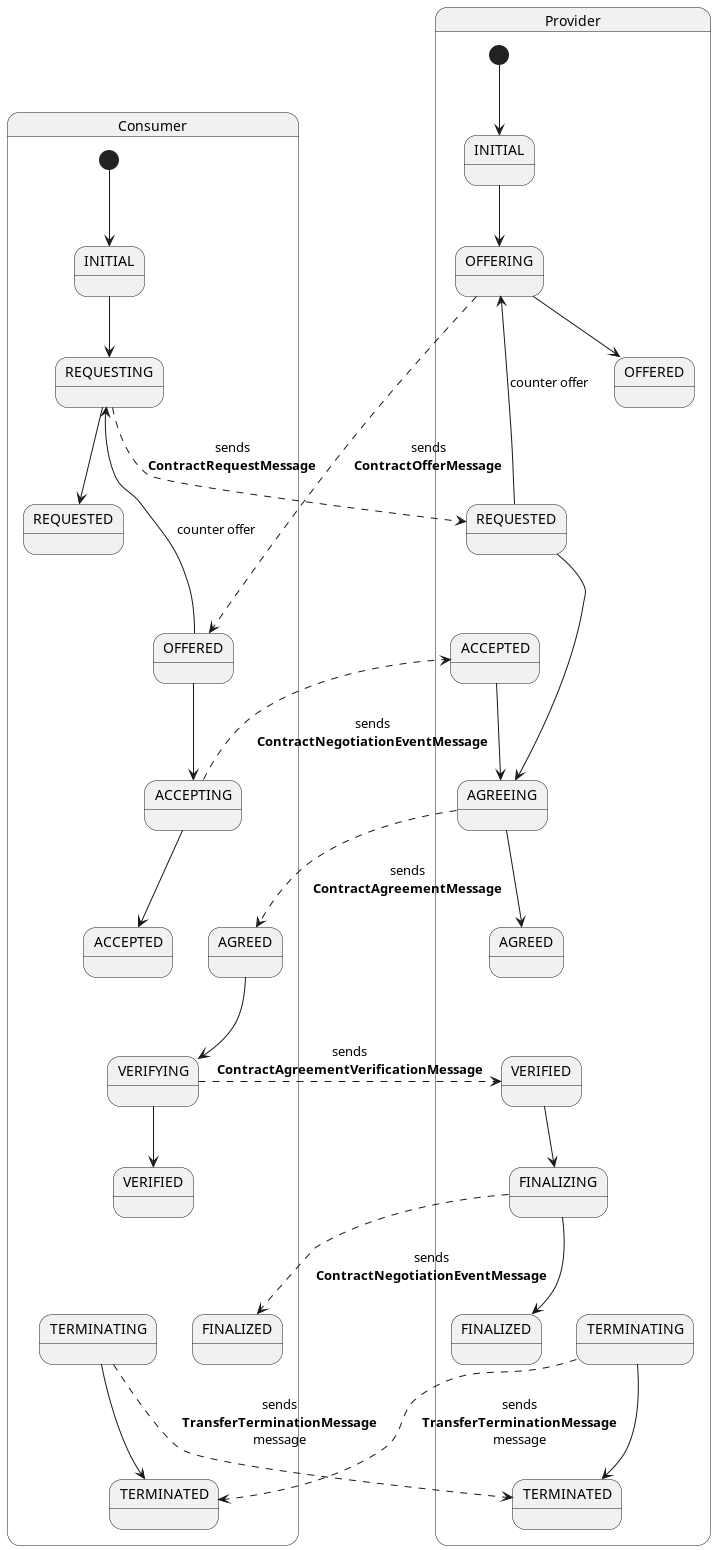
Contract negotiations are asynchronous in nature. That means after initiating them, they become (potentially long-running) stateful processes that are advanced by an internal state machine. The current state of the negotiation can be queried and altered through the management API.
Here’s a diagram of the state machine applied to contract negotiations:
A contract negotiation can be initiated from the consumer side by sending a ContractRequest to the connector
management API.
{
  "@context": [
    "https://w3id.org/edc/connector/management/v2"
  ],
  "@type": "ContractRequest",
  "counterPartyAddress": "http://provider-address",
  "protocol": "dataspace-protocol-http",
  "policy": {
    "@context": "http://www.w3.org/ns/odrl.jsonld",
    "@type": "odrl:Offer",
    "@id": "offer-id",
    "assigner": "providerId",
    "permission": [],
    "prohibition": [],
    "obligation": [],
    "target": "assetId"
  },
  "callbackAddresses": [
    {
      "transactional": false,
      "uri": "http://callback/url",
      "events": [
        "contract.negotiation"
      ],
      "authKey": "auth-key",
      "authCodeId": "auth-code-id"
    }
  ]
}
The counterPartyAddress is the address where to send the ContractRequestMessage via the specified protocol (
currently dataspace-protocol-http)
The policy should hold the same policy associated to the data offering chosen from the catalog, plus
two additional properties:
assignerthe providersparticipantIdtargetthe asset (dataset) ID
In addition, the (optional) callbackAddresses array can be used to get notified about state changes of the
negotiation. Read more on callbacks in the section
about events and callbacks.
Note: if the
policysent by the consumer differs from the one expressed by the provider, the contract negotiation will fail and transition to aTERMINATEDstate.
5. Contract agreements
Once a contract negotiation is successfully concluded (i.e. it reaches the FINALIZED state), it “turns into” a
contract agreement. It is always the provider connector that gives the final approval. Contract agreements are
immutable objects that contain the final, agreed-on policy, the ID of the asset that the contract was negotiated for,
the IDs of the negotiation parties and the exact signing date.
Note that in future iterations contracts will be cryptographically signed to further support the need for immutability and non-repudiation.
Like contract definitions, contract agreements are entities that only exist within the bounds of a connector.
About terminating contracts: once a contract negotiation has reached a terminal
state
TERMINATED or FINALIZED, it becomes immutable. This could be compared to not being able to scratch a signature off a
physical paper contract. The agreed-on policy, asset ID, parties and signing date can therefore never change.
While the agreement itself stays immutable, a provider may still need to stop honoring it, for example because the underlying data source is decommissioned or the business relationship ends. For this EDC provides a dedicated mechanism: contract agreement retirement (see below). Any further cancellation semantics beyond retirement are highly individual to each dataspace, so EDC cannot make an assumption there and leaves them to be handled through other channels like eventing systems.
5.1 Retiring a contract agreement
Retirement lets a provider invalidate a contract agreement after it has been finalized. A retired agreement:
- can no longer be used to start new transfer processes, and
- causes ongoing transfer processes that rely on it to be terminated.
Retirement does not mutate the immutable part of the agreement. Instead, it is tracked by three dedicated fields on the
ContractAgreement entity:
| Field | Type | Meaning |
|---|---|---|
retired | boolean | Whether the agreement is retired. Defaults to false. |
retirementReason | String | The reason supplied when retiring, or null if not retired. |
retirementDate | long (epoch sec) | When the agreement was retired, or 0 if not retired. |
How retirement is enforced. Enforcement is implemented as a policy pre-validator,
AgreementRetirementValidator, which is registered for both the transfer.process scope and the
policy.monitor scope. The validator simply fails policy evaluation whenever
contractAgreement().isRetired() is true:
- In the
transfer.processscope this makes any attempt to start a transfer against a retired agreement fail. - In the
policy.monitorscope the Policy Monitor re-evaluates the policy of running transfers and terminates those whose agreement has become retired.
Termination of in-flight transfers depends on the Policy Monitor extension being enabled on the provider. Without it, already-running transfers are not swept, though new transfers are still refused.
API. Retirement is triggered via the Management API by issuing a POST to the agreement’s retire sub-resource.
The endpoint is available on both API versions:
- v4:
POST /v4/contractagreements/{id}/retire - v5:
POST /v5/participants/{participantContextId}/contractagreements/{id}/retire
The request body is a JSON-LD document of type RetireAgreement carrying a mandatory reason:
{
  "@context": {
    "@vocab": "https://w3id.org/edc/v0.0.1/ns/"
  },
  "@type": "RetireAgreement",
  "reason": "The underlying data source has been decommissioned"
}
The call returns 404 Not Found if no agreement with the given ID exists, and 409 Conflict if the agreement is
already retired.
5.2 Un-retiring a contract agreement
A retired agreement can be brought back into service. Un-retiring resets the retirement fields (retired=false,
retirementReason=null, retirementDate=0), after which the agreement can again be used to start transfers.
Because un-retiring is a plain action with no extra information to supply, it takes no request body:
- v4:
POST /v4/contractagreements/{id}/unretire - v5:
POST /v5/participants/{participantContextId}/contractagreements/{id}/unretire
The call returns 404 Not Found if no agreement with the given ID exists, and 409 Conflict if the agreement is not
currently retired.
5.3 Retirement events
Both operations emit events through the EventRouter, so
extensions and external systems can react to them:
| Event | Event name | Payload |
|---|---|---|
ContractAgreementRetired | contract.agreement.retired | contractAgreementId, participantContextId, reason |
ContractAgreementUnretired | contract.agreement.unretired | contractAgreementId, participantContextId |
6. Catalog
The catalog contains the “data offerings” of a connector and one or multiple service endpoints to initiate a negotiation for those offerings.
Every data offering is represented by a Dataset object which
contains a policy and one or multiple Distribution
objects. A Distribution should be understood as a variant
or representation of the Dataset. For instance, if a file is accessible via multiple transmission channels from a
provider (HTTP and FTP), then each of those channels would be represented as a Distribution. Another example would be
image assets that are available in different file formats (PNG, TIFF, JPEG).
A DataService object specifies the endpoint where contract
negotiations and transfers are accepted by the provider. In practice, this will be the DSP endpoint of the connector.
The following example shows an HTTP response to a catalog request, that contains one offer that is available via two
channels HttpData-PUSH and HttpData-PULL.
catalog example
{
  "@id": "567bf428-81d0-442b-bdc8-437ed46592c9",
  "@type": "dcat:Catalog",
  "dcat:dataset": [
    {
      "@id": "asset-2",
      "@type": "dcat:Dataset",
      "odrl:hasPolicy": {
        "@id": "c2Vuc2l0aXZlLW9ubHktZGVm:YXNzZXQtMg==:MzhiYzZkNjctMDIyNi00OGJjLWFmNWYtZTQ2ZjAwYTQzOWI2",
        "@type": "odrl:Offer",
        "odrl:permission": [],
        "odrl:prohibition": [],
        "odrl:obligation": {
          "odrl:action": {
            "@id": "use"
          },
          "odrl:constraint": {
            "odrl:leftOperand": {
              "@id": "DataAccess.level"
            },
            "odrl:operator": {
              "@id": "odrl:eq"
            },
            "odrl:rightOperand": "sensitive"
          }
        }
      },
      "dcat:distribution": [
        {
          "@type": "dcat:Distribution",
          "dct:format": {
            "@id": "HttpData-PULL"
          },
          "dcat:accessService": {
            "@id": "a6c7f3a3-8340-41a7-8154-95c6b5585532",
            "@type": "dcat:DataService",
            "dcat:endpointDescription": "dspace:connector",
            "dcat:endpointUrl": "http://localhost:8192/api/dsp",
            "dct:terms": "dspace:connector",
            "dct:endpointUrl": "http://localhost:8192/api/dsp"
          }
        },
        {
          "@type": "dcat:Distribution",
          "dct:format": {
            "@id": "HttpData-PUSH"
          },
          "dcat:accessService": {
            "@id": "a6c7f3a3-8340-41a7-8154-95c6b5585532",
            "@type": "dcat:DataService",
            "dcat:endpointDescription": "dspace:connector",
            "dcat:endpointUrl": "http://localhost:8192/api/dsp",
            "dct:terms": "dspace:connector",
            "dct:endpointUrl": "http://localhost:8192/api/dsp"
          }
        }
      ],
      "description": "This asset requires Membership to view and SensitiveData credential to negotiate.",
      "id": "asset-2"
    }
  ],
  "dcat:distribution": [],
  "dcat:service": {
    "@id": "a6c7f3a3-8340-41a7-8154-95c6b5585532",
    "@type": "dcat:DataService",
    "dcat:endpointDescription": "dspace:connector",
    "dcat:endpointUrl": "http://localhost:8192/api/dsp",
    "dct:terms": "dspace:connector",
    "dct:endpointUrl": "http://localhost:8192/api/dsp"
  },
  "dspace:participantId": "did:web:localhost%3A7093",
  "participantId": "did:web:localhost%3A7093",
  "@context": {}
}
Catalogs are ephemeral objects, they are not persisted or cached on the provider side. Everytime a consumer participant makes a catalog request through DSP, the connector runtime has to evaluate the incoming request and build up the catalog specifically for that participant. The reason for this is that between two subsequent requests from the same participant, the contract definition or the claims or the participant could have changed.
The relevant component in EDC is the DatasetResolver, which resolves all contract definitions that are relevant to a
participant filtering out those where the participant does not satisfy the access policy and collects all the assets
therein.
In order to determine how an asset can be distributed, the resolver requires knowledge about the data planes that are
available: the transfer types of the
registered data planes, matched against the
profiles of the asset’s dataplaneMetadata, make up the list of Distributions for an asset.
For details about the FederatedCatalog, please refer to its documentation.
7 Transfer processes
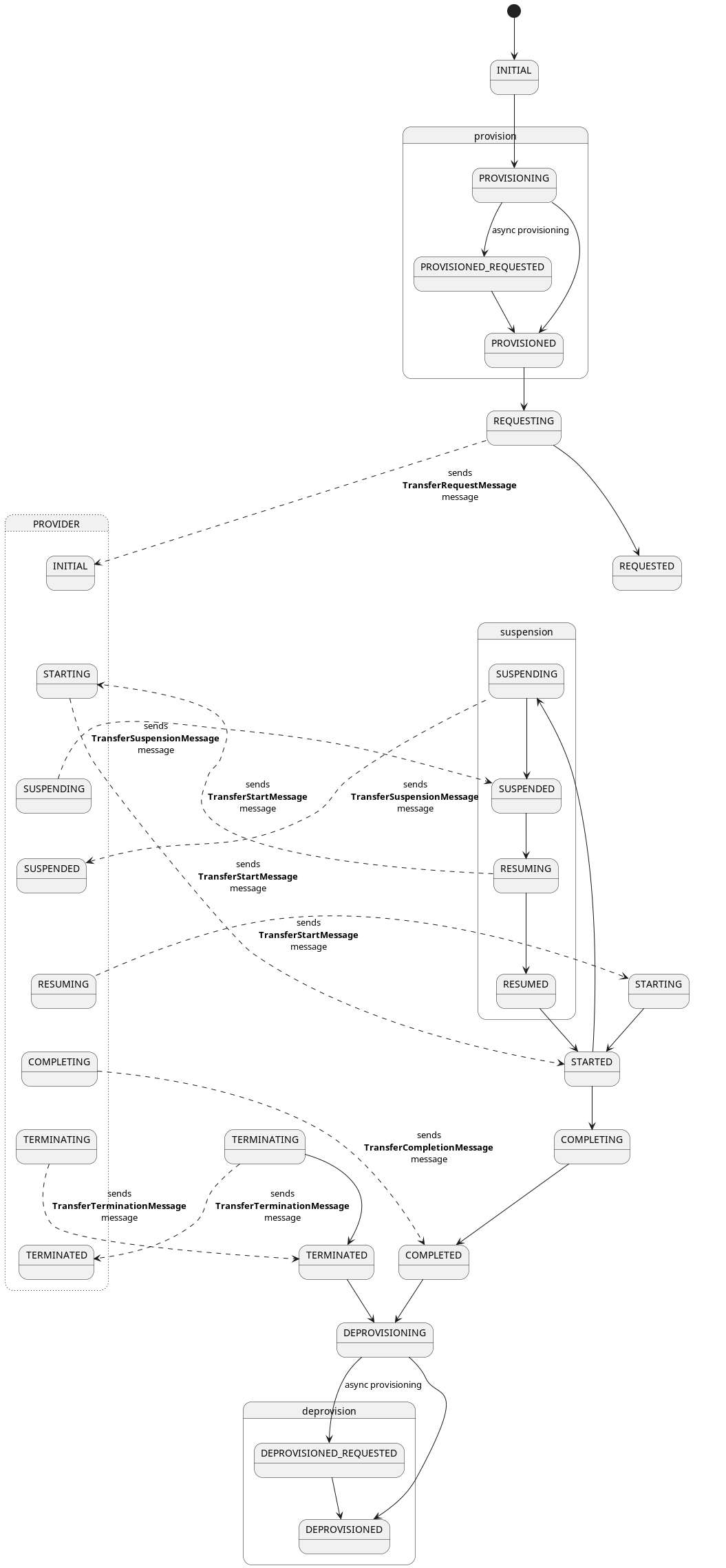
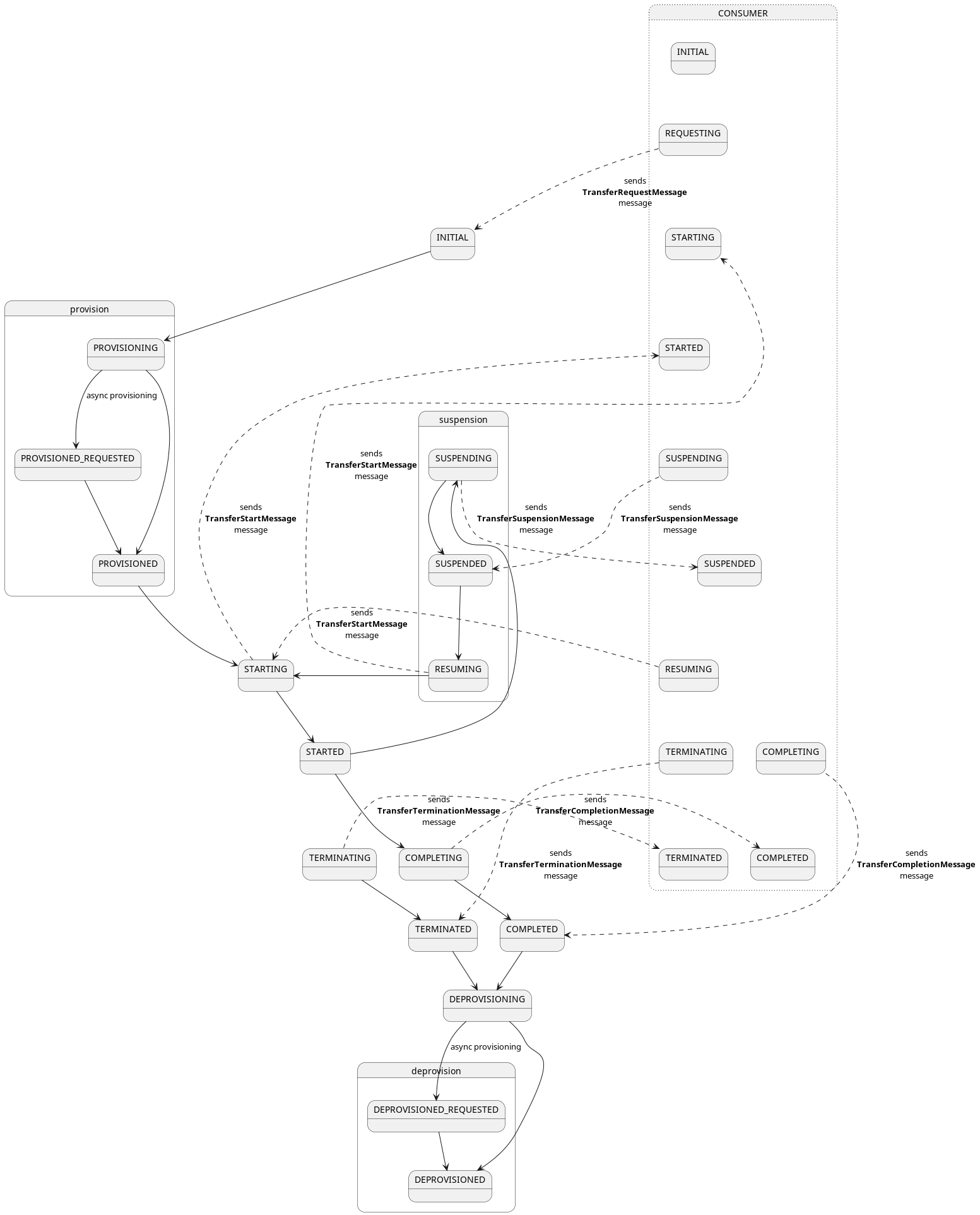
A TransferProcess is a record of the data sharing procedure between a consumer and a provider. As they traverse
through the system, they transition through several
states (TransferProcessStates).
Once a contract is negotiated and an agreement is reached, the
consumer connector may send a transfer initiate request to start the transfer. The consumer control plane first asks
its data plane to prepare the data flow, and the provider control plane asks its data plane to start it, both through
Data Plane Signaling. A data plane may need to take some preparatory
steps, for example deploying a temporary object store where the provider should put the data, or anonymizing the data
before sending it out: it does so on its own, and may answer asynchronously, in which case the transfer process waits in
PREPARATION_REQUESTED or STARTUP_REQUESTED.
Once that is done, the transfer begins in earnest, between the data planes, according to the transfer type.
Once the transmission has completed, the transfer process will transition to the COMPLETED state, or - if an error
occurred - to the TERMINATED state.
The Management API provides several endpoints to manipulate data transfers.
Here is a diagram of the state machine applied to transfer processes on consumer side:
Here is a diagram of the state machine applied to transfer processes on provider side:
A transfer process can be initiated from the consumer side by sending a TransferRequest to the connector Management
API:
{
  "@context": [
    "https://w3id.org/edc/connector/management/v2"
  ],
  "@type": "TransferRequest",
  "protocol": "dataspace-protocol-http",
  "counterPartyAddress": "http://provider-address",
  "contractId": "contract-id",
  "transferType": "transferType",
  "dataplaneMetadata": {
    "labels": [ "eu" ],
    "properties": {
      "key": "value"
    }
  },
  "privateProperties": {
    "private-key": "private-value"
  },
  "callbackAddresses": [
    {
      "transactional": false,
      "uri": "http://callback/url",
      "events": [
        "contract.negotiation",
        "transfer.process"
      ],
      "authKey": "auth-key",
      "authCodeId": "auth-code-id"
    }
  ]
}
where:
counterPartyAddress: the address where to send theTransferRequestMessagevia the specifiedprotocol( currentlydataspace-protocol-http)contractId: the ID of a previously negotiated contract agreement which is a result of the contract negotiation process.transferTypedefines how the data transfer should happen.dataplaneMetadata: thelabelsthe consumer’s data plane must have, andpropertiespassed to it asmetadata, e.g. where a push transfer should put the data (see About data addresses).callbackAddressescustom hooks in order bo be notified about state transition of the transfer process.privateProperties: custom properties not shared with the counter-party.
7.1 Transfer and data flows types
The transfer type defines the channel (Distribution) for the data transfer and it depends on the capabilities of
the data planes if it can be fulfilled. The transferType available for a
data offering is available in the dct:format of the Distribution when inspecting the catalog response.
Each transfer type also characterizes the type of the flow, which can be either pull or push and it’s data can be either finite or non-finite
7.1.1 Consumer Pull
A pull transfer is when the consumer receives information (in the form of a data address) on how to retrieve data from the Provider. Then it’s up to the consumer data plane to use this information for pulling the data.
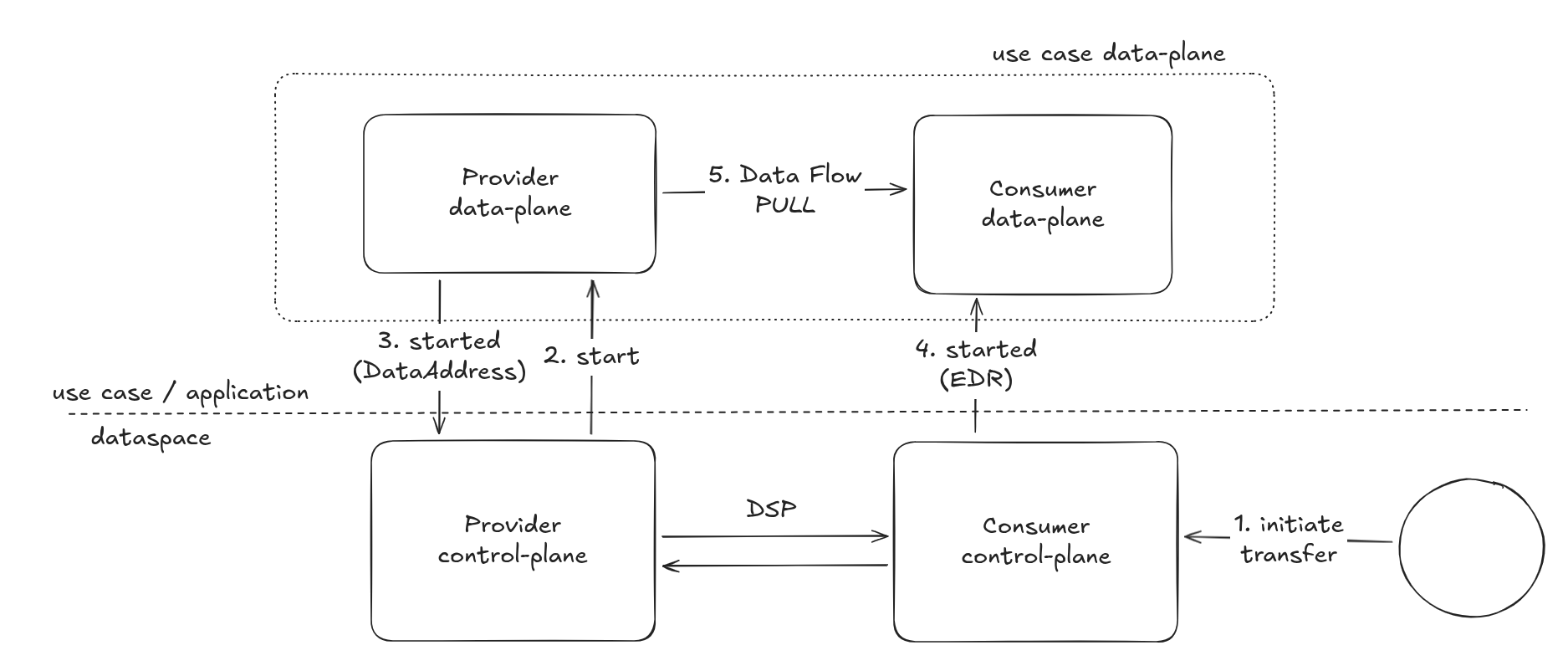
Provider and consumer agree to a contract (not displayed in the diagram)
- The consumer initiates the transfer process through the Management API. The consumer control plane selects a data
plane and sends it a
preparemessage (not displayed in the diagram), then sends aTransferRequestMessageto the provider. - The provider control plane selects a data plane and sends it a
startmessage through Data Plane Signaling, with thedataplaneMetadataof the asset. - The provider data plane creates the data address, i.e. the endpoint and the credentials with which the consumer
fetches the data, and returns it (in its answer, or later with a
startednotification). The provider control plane sends it to the consumer in theTransferStartMessage. - The consumer control plane hands the data address to its data plane with a
startedmessage. Applications can also receive it through the callbacks of thetransfer.process.startedevent. - The consumer data plane fetches the data from the provider data plane, which validates the credentials it issued.
7.1.2 Provider Push
A push transfer is when the Provider data plane initiates sending data to the destination specified by the consumer.
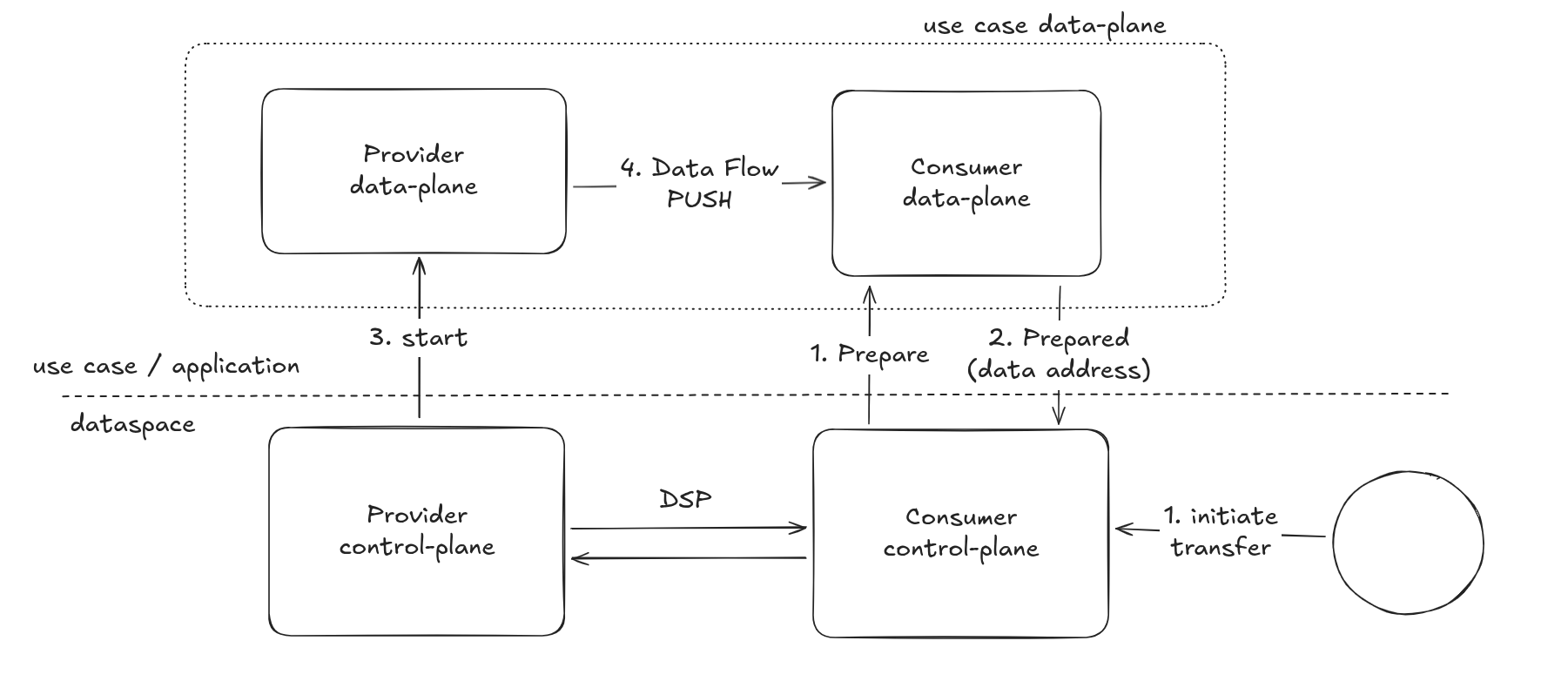
Provider and consumer agree to a contract (not displayed in the diagram)
- The consumer initiates the transfer process through the Management API. The consumer control plane selects a data
plane and sends it a
preparemessage. - The consumer data plane returns the destination as data address (in its answer, or later with a
preparednotification). The consumer control plane sends it to the provider in theTransferRequestMessage. - The provider control plane selects a data plane and sends it a
startmessage with thedataplaneMetadataof the asset and the consumer’s data address. - The provider data plane pushes the data to the destination.
7.1.3 Finite and Non-Finite Data
The characterization of the data applies to either push and pull transfers. Finite data transfers cause the transfer
process to transition to the state COMPLETED, once the transmission has finished. For example a transfer of a single
file that is hosted and transferred into a cloud storage system.
Non-finite data means that once the transfer process request has been accepted by the provider the transfer process is
in the STARTED state until it gets terminated by the consumer or the provider. Examples of Non-finite data are streams
or API endpoints.
On the provider side transfer processes can also be terminated by the policy monitor that periodically watches over the ongoing transfer and checks if the associated contract agreement still fulfills the contract policy.
7.2 About data addresses
A data address describes where the data of a transfer is: in a “provider-push” scenario, the destination the consumer data plane provides, e.g. an object storage container or a directory on a file system; in a “consumer-pull” scenario, the endpoint and the credentials the provider data plane provides.
A data address is created and used only by the data planes. It is a schemaless object, and the provider and the consumer data planes need to have a common understanding of the required fields: if the provider is supposed to put the data into a file share, the data address will likely contain the host URL, a path and possibly a file name. The transfer type (the DPS profile) is the way to establish that “understanding”: the provider offers an asset only with the transfer types its data planes support, and the consumer picks one of them in the transfer request.
7.3 Transfer process callbacks
In order to get timely updates about status changes of a transfer process, we could simply poll the management API by
firing a GET /v*/transferprocesses/{tp-id}/state request every X amount of time. That will not only put unnecessary
load on the connector,
you may also run into rate-limiting situations, if the connector is behind a load balancer of some sort. Thus, we
recommend using event callbacks.
Callbacks must be specified when requesting to initiate the transfer:
{
  // ...
  "callbackAddresses": [
    {
      "transactional": false,
      "uri": "http://callback/url",
      "events": [
        "transfer.process"
      ],
      "authKey": "auth-key",
      "authCodeId": "auth-code-id"
    }
  ]
  //...
}
Currently, we support the following events:
transfer.process.initiatedtransfer.process.preparationRequestedtransfer.process.preparedtransfer.process.requestedtransfer.process.startedtransfer.process.suspendedtransfer.process.resumingtransfer.process.completedtransfer.process.terminatedtransfer.process.dataflow.errored: the data plane reported a non-recoverable error of the data flow; the transfer process doesn’t change state
The connector’s event dispatcher will send invoke the webhook specified in the uri field passing the event
payload as JSON object.
More info about events and callbacks can be found here.
8 Querying with QuerySpec and Criterion
Most of the entities can be queried with the QuerySpec object, which is a generic way of expressing limit, offset,
sort and filters when querying a collection of objects managed by the EDC stores.
Here’s an example of how a QuerySpec object might look like when querying for Assets via management APIs:
{
  "@context": [
    "https://w3id.org/edc/connector/management/v2"
  ],
  "@type": "QuerySpec",
  "limit": 1,
  "offset": 1,
  "sortField": "createdAt",
  "sortOrder": "DESC",
  "filterExpression": [
    {
      "operandLeft": "https://w3id.org/edc/v0.0.1/ns/description",
      "operator": "=",
      "operandRight": "This asset"
    }
  ]
}
which filters by the description custom property being equals to This asset. The query also paginates the result
with limit and p set to 1. Additionally a sorting strategy is in place by createdAt property in descending order (
the default is ASC)
Note: Since custom properties are persisted in their expanded form, we have to use the expanded form also when querying.
The filterExpression property is a list of Criterion, which expresses a single filtering condition based on:
operandLeft: the property to filter onoperator: the operator to apply e.g.=operandRight: the value of the filtering
The supported operators are:
- Equal:
= - Not equal:
!= - In:
in - Like:
like - Ilike:
ilike(same aslikebut ignoring case sensitive) - Contains:
contains
Note: multiple filtering expressions are always logically conjoined using an “AND” operation.
The properties that can be expressed in the operandLeft of a Criterion depend on the shape of the entity that we are
want to query.
Note: nested properties are also supported using the dot notation.
QuerySpec can also be used when doing the catalog request using the querySpec property in the catalog request
payload for filtering the datasets:
{
  "@context": [
    "https://w3id.org/edc/connector/management/v2"
  ],
  "counterPartyAddress": "http://provider/api/dsp",
  "protocol": "dataspace-protocol-http",
  "counterPartyId": "providerId",
  "querySpec": {
    "filterExpression": [
      {
        "operandLeft": "https://w3id.org/edc/v0.0.1/ns/description",
        "operator": "=",
        "operandRight": "This asset"
      }
    ]
  }
}
Entities are backed by stores for doing CRUD operations. For each entity
there is an associated store interface (SPI). Most of the stores SPI have a query like method which takes a
QuerySpec type as input and returns the matched entities in a collection. Individual implementations are then
responsible for translating the QuerySpec to a proper fetching strategy.
The description on how the translation and mapping works will be explained in each implementation. Currently EDC support out of the box:
- In-memory stores (default implementation).
- SQL stores provided as extensions for each store, mostly tailored for and tested with PostgreSQL.
For guaranteeing the highest compatibility between store implementations, a base tests suite is provided for each store that each technology implementors need to fulfill in order to have a minimum usable store implementation.
2 - Policy Monitor
Some transfer types, once accepted by the provider, never reach the COMPLETED state. Streaming and HTTP transfers in consumer pull scenario are examples of this. In those scenarios the transfer will remain active (STARTED) until it gets terminated either manually by using the transfer processes management API, or automatically by the policy monitor, if it has been configured in the EDC runtime.
The policy monitor (PolicyMonitorManager) is a component that watches over ongoing transfers on the provider side and ensures that the associated policies are still valid. The default implementation of the policy monitor tracks the monitored transfer processes in it’s own entity PolicyMonitorEntry stored in the PolicyMonitorStore.
Once a transfer process transition to the STARTED state on the provider side, the policy monitor gets notified through the eventing system of EDC and start tracking transfer process. For each monitored transfer process in the STARTED state the policy monitor retrieves the policy associated (through contract agreement) and runs the Policy Engine using the policy.monitor as scope.
If the policy is no longer valid, the policy monitor marks the transfer process for termination (TERMINATING) and stops tracking it.
The data plane also gets notified through the data plane signaling protocol about the termination of the transfer process, and if accepted by the data plane, the data transfer terminates as well.
Note for implementors
Implementors that want a Policy function to be evaluated at the policy monitor layer need to bind such function to the policy.monitor scope.
The policy evaluation happens in the background, without a request of the consumer. The PolicyMonitorContext available for functions in the policy.monitor scope contains:
- the
ContractAgreementand theInstantat the time of the evaluation; - a
ParticipantAgentrebuilt from the agreement: its identity is the consumer’s, and its claims are the ones of the consumer’s verified credentials stored with the agreement when it was reached. Functions that check credentials therefore evaluate the credentials the consumer presented at that time; they are not requested again; - the participant context the transfer belongs to, so that CEL expressions can use
ctx.agentandctx.partnersin this scope too.
A bundled example of a Policy function that runs in the policy.monitor scope is the ContractExpiryCheckFunction which checks if the contract agreement is not expired.
3 - Protocol Extensions
The EDC officially supports the Dataspace protocol using the HTTPs bindings, but since it is an extensible platform, multiple protocol implementations can be supported for inter-connectors communication. Each supported protocols is identified by a unique key used by EDC for dispatching a remote message.
1. RemoteMessage
At the heart of EDC message exchange mechanism lies the RemoteMessage interface, which describes the protocol, the counterPartyAddress and the counterPartyId used for a message delivery.
RemoteMessage extensions can be divided in three groups:
- Catalog (
catalog-spi) - Contract negotiation (
contract-spi) - Transfer process (
transfer-spi)
Each RemoteMessage is:
- Delivered to the counter-party using a RemoteMessageDispatcher.
- Received by the counter-party through the protocol implementation (e.g. HTTP) and handled by the protocol services layer.
1.1 Delivering messages with RemoteMessageDispatcher
Each protocol implements a RemoteMessageDispatcher:
public interface RemoteMessageDispatcher {

    String protocol();

    <T, M extends RemoteMessage> CompletableFuture<StatusResult<T>> dispatch(Class<T> responseType, M message);

}
and it is registered in the RemoteMessageDispatcherRegistry, where it gets associated to the protocol defined in RemoteMessageDispatcher#protocol.
Internally EDC uses the RemoteMessageDispatcherRegistry whenever it needs to deliver a RemoteMessage to the counter-party. The RemoteMessage then gets routed to the right RemoteMessageDispatcher based on the RemoteMessage#getProtocol property.
EDC also uses
RemoteMessageDispatcherRegistryfor non-protocol messages when dispatching event callbacks
1.2 Handling incoming messages with protocol services
On the ingress side, protocol implementations should be able to receive messages through the network (e.g. API Controllers), deserialize them into the corresponding RemoteMessages and then dispatching them to the right protocol service.
Protocol services are three:
CatalogProtocolServiceContractNegotiationProtocolServiceTransferProcessProtocolService
which handle respectively Catalog, ContractNegotiation and TransferProcess messages.
2. DSP protocol implementation
The Dataspace protocol implementation is available under the data-protocols/dsp subfolder in the Connector repository. EDC 1.0 implements DSP 2025-1 only (the versions 08 and 2024/1 were removed), identified by the protocol key dataspace-protocol-http:2025-1:
dsp-2025: the endpoints of a single participant runtime, under/2025-1/catalog,/2025-1/negotiationsand/2025-1/transfers;dsp-virtual: the endpoints of a multi-participant runtime, under/{participantContextId}/{profileId}/…, where the dataspace profile determines the protocol version, binding and JSON-LD namespace of the exchange;dsp-version: the version metadata,/.well-known/dspace-version(/{participantContextId}/.well-known/dspace-versionin a multi-participant runtime);dsp-core,dsp-lib,dsp-spi,dsp-http-spi: the shared dispatcher, transformers and SPIs.
It extends the RemoteMessageDispatcher with the interface DspHttpRemoteMessageDispatcher (dsp-spi), which adds an additional method for registering message handlers.
The implementation of the three DSP specifications:
is separated in multiple extension modules grouped by specification.
This allows for example to build a runtime that only serves a dsp catalog requests useful the Management Domains scenario.
Each specification implementation defines handlers, transformers for RemoteMessages and exposes HTTP endpoints.
The
dspimplementation also provide HTTP endpoints for the DSP common functionalities.
2.1 RemoteMessage handlers
Handlers map a RemoteMessage to an HTTP Request and instruct the DspHttpRemoteMessageDispatcher how to extract the response body to a desired type.
2.2 HTTP endpoints
Each dsp-*-http-api module exposes its own API Controllers for serving the specification requests. Each request handler transforms the JSON-LD in input, if present, into a RemoteMessage and then calls the protocol service layer.
2.2 RemoteMessage transformers
Each dsp-*-transform module registers in the DSP API context Transformers for mapping JSON-LD objects from and to RemoteMessages.